Mandarin-form Shidio-Korean
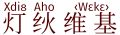
Mandarin-form Shidio-Korean ( ) is a writing system that uses the Shidinn alphabet to write the modern Korean language.
This Korean-to-Shidinn mapping differs from Shidinn Hangul mapping in some ways. The vowel mapping plan still needs to be revised.
Letters
Consonants
| Hangul | Shidinn | Note |
|---|---|---|
| ㅂ | b | |
| ㅃ | | |
| ㅍ | p | |
| ㅁ | m | |
| ㅈ | z | z + i = j |
| ㅉ | | + i = |
| ㅊ | | + i = q |
| ㅅ | s | s + i = x |
| ㅆ | (onset) ss (coda) |
+ i = |
| ㄹ | r | |
| ㅇ | 4 (onset) (coda) |
, 4。 4+i=y 4+u=w +u= |
| ㄴ | l | l+i=n l+u=v |
| ㄷ | d | d+u= |
| ㄸ | | +u= |
| ㅌ | t | t+u= |
| ㄱ | g | g+u= |
| ㄲ | (onset) gg (coda) |
+u= |
| ㅋ | k | k+u=c |
| ㅎ | h | h+u=f |
Shidinido designers made the following vowel plan based on existing dialects. More specifically, the assignment of nasal vowels is loosely based on Ajthreac's Shandong Shidinn.
The use of remains unclear.
| | Shidinn ( ) | When followed by ㅇ coda (default is vowel + ) |
|
|---|---|---|---|
| ㅏ | | | |
| ㅐ | | | |
| ㅑ | | | |
| ㅒ | | | |
| ㅓ | | ∞ | |
| ㅔ | | | |
| ㅕ | | ∞ | |
| ㅖ | | | |
| . | | ||
| ㅗ | o | | |
| ㅘ | | | |
| ㅙ | | | |
| ㅚ | | ||
| ㅛ | | | |
| ㅜ | | | |
| ㅝ | | ∞ | |
| ㅞ | | | |
| ㅟ | | ||
| ㅠ | | | |
| ㅡ | | ||
| ㅢ | | ||
| ㅣ | |
Special cases
When , , , , is followed by "i", it becomes , , , , .
When , , , , , , , is followed by "u", it becomes , , , , , , ,
Some of the suffixes, such as 는, can be shortened by omitting the vowel. The possessive 의 can be shortened to 'E.
Radicals
Radicals can be added as in Mandarin Shidinn. The letters representing radicals are considered silent.