
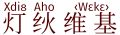
The Confession of Huáng Quèfēi
| This artical was translated automatically using Google Translate (or similar) and may have been manually improved. Please be aware that unless it has been reviewed by someone who speaks the original language of the page, then it may contain errors, including incorrect information not present in the original version of the page. |
10 The Confession of Huáng Quèfēi
1How difficult is it to create a new language and script? It's very difficult. It took me thirty years to invent Shidinn Alphabet Chinese.
2My name is "Huang Quefei," not my real name, but my online name or stage name.3There is a poem that says, "The Yellow Crane has flown away and will never return." I have never seen a Yellow Crane, but I have seen a Yellow Sparrow.4I was eleven or twelve years old then, herding cattle on the mountain in my hometown of Shaoyang, Hunan. I heard a yellow sparrow chirping, as if it was saying, "Go to heaven, go to heaven..." The sparrow flew and flew, but when it reached halfway up the sky, it lost its strength and fell down. Its mournful cry sounded like, "I'm going to die, I'm going to die..."5I still remember that scene vividly. Now I'm middle-aged, my career is going poorly, and my love life has failed. I'm just like a yellow sparrow that wanted to fly up to the sky but fell down halfway. That's why I have this name—"The Flying Yellow Sparrow".
6When I first invented the Shidinn Alphabet, I was very young. I saw some symbols that had been left over from some unknown time, and I found them very peculiar. At that moment, I wondered if I could create some letters myself.7Later, when I was in middle school, around 1990, it was difficult to input Chinese characters on a computer. Inputting them required using encoding, which went against our habits and required special learning. So I wanted to make Chinese characters alphabetized so that Chinese could be input as easily as English.8I've always felt that Mandarin has some shortcomings, especially with so many homophones, making it easy to make mistakes when writing, and even more so when typing on a computer.9So when I started creating the Shidinn language, I wanted to create it as a language suitable for computer input, to turn Chinese into an international language, like English, where you can type the text directly on the keyboard without encoding conversion; at the same time, it would be easier for foreigners to learn, including many southerners like myself who can't learn northern Mandarin, can't distinguish between 'n' and 'l', or between front and back nasal sounds. If native speakers can't learn it, it's even more difficult for foreigners to learn Mandarin.10So I had the idea of alphabetizing the Chinese language. The initial design of the Shidinn Alphabet was not represented by Latin letters and Arabic numerals as it is now, but rather by combining the original radicals of Chinese characters with some cursive script.11However, I later felt that using internationally available alphabetic symbols was more in line with international trends and also better suited my starting point of "facilitating computer input".
12The Shidinn language is not only an alphabetic form of Chinese, but it also has no homophones. It gives each Chinese character a different pinyin, thus avoiding many problems associated with homophones.13Originally, Chinese phono-semantic characters have radicals and phonetic components, so based on the characteristics of the Chinese language, I transformed Chinese characters into polysyllabic words composed of initial consonants.14For example, the character “打” has the radical for hand and is pronounced as en (the top letter of the character is written as ), and the radical for ding is pronounced as din (the top letter of the character is written as ). So this character is pronounced as endin (), which is very easy.15Therefore, Shidinn has a strong regularity and is even easier to learn than English, which can expand the international influence of Chinese and facilitate our foreign exchanges.
16Over the years, I have gradually accumulated many scattered manuscripts. These manuscripts were often written during the most unhappy times in my life, when I was under pressure. Many of them actually came from inspiration.17Sometimes I lie in bed, half-awake and half-dazed, as if my soul has completely left my body, and that's when inspiration might strike.18As an example, it came to my mind when I was pondering in my friend’s home that, there are phonemes z, c, s, r in Pinyin, but not a dental ‘-padding’ consonant (parallel to z, c, s, r). (I considered 尤, but for its complexity, 卜 is chosen)19I found it strange that I kept repeating this syllable, afraid of forgetting the pronunciation. I felt that it was destined by heaven that such a pronunciation was meant for me to discover. So I ultimately preserved this consonant, which is not found in Chinese Pinyin, in the Shidinn language.
20For a long time, I was the only one who created the Shidinn language, and I was the only one who used it; it was always just me talking to myself.21Sometimes I worry that if I were to pass away, the Shidinn Alphabet would become an eternal mystery along with me, and no one would ever learn Shidinn again, nor would anyone be as dedicated to promoting it as I am.22I have valued this matter all my life, and I can say that I have put all my heart and soul into this spark. If I don't work harder, it will all be wasted.23But my real life is too tragic. There are many difficulties in life. I have no money, no wife, and my health is not good. My energy has been exhausted. Sometimes I feel that there is no point in living. If it weren't for the Shidinn language cause, I wouldn't have been able to persevere and I wouldn't be where I am today. Shidinn language has become my hope for living. It would be a lifelong regret if I didn't promote it.
24In an attempt to get the country to accept my research, I went to Beijing twice. It was a really tough time back then. I didn't have much money, and I could only sleep under the signal base station at Beijing West Railway Station.25Beijing is very strict. When I went to Zhongnanhai, the people there ignored me; when I went to Tiananmen Square, the armed police wouldn't let me in; when I went to the Education Commission, they asked me "Who are you?" but still wouldn't let me in.26I want to give the Shidinn Alphabet to the country, but I can't communicate with the people in the country, so I want to leave my address and contact information with them.27I persisted like this for a long time, but ultimately made no progress and had to go home. After returning home, there was no way out, no official recognized me, and no one even remembered my name.28Perhaps the country's policies don't even require the Shidinn language, so I can only post online, on Zhihu and Bilibili. Without the official route, I'll just have to take it one step at a time from now on.
29However, I have a few friends online who support me, so even if I don't succeed, I've still fulfilled a small wish.30The first person to support me wasn't actually "Raymond," but someone named "Wolong."31At that time, I was essentially fighting against all of China. Everyone was against me. Because I was not familiar with Pinyin, my remarks were met with fierce criticism. The attacks and insults were simply unbearable. Some people from Shaoyang even said that I was a disgrace to Shaoyang.32Later, "Wolong" came to comfort me and became my first friend. However, he was probably the same kind of person as me, and his education level was not high, so he could not help me develop the Shidinn language like the other friends who came later.
33I don't like to interfere with other people's ideas. If others can improve Shidinn to make it more suitable for everyone to learn, then I don't think they are going astray.
See also
In other languages
- 本页中文版见黄雀飞的自白。